



Modern PMOs: Turning Strategy into Measurable Business Impact
Oct 22, 2025 | By Patrick Ng
Many business leaders have a complicated relationship with their Project Management Office (PMO). They see it as a necessary cost center — a team focused on tracking timelines, managing spreadsheets, and enforcing compliance. While these activities have their place, they often fail to answer the most important question: “Is this project delivering real business value?” A traditional PMO that measures success by on-time, on-budget delivery alone is missing the point. It’s tracking activity, not impact.
The modern PMO is different. It functions as a strategic enabler, not just a process administrator. It provides leaders with the clarity to select the right projects, the control to ensure they are delivered effectively, and the confidence that the intended business benefits will be realized. This evolution from a reporting function to a value-delivery engine is critical for turning your company’s strategy into measurable results.

What Does a Modern, Value-Driven PMO Look Like?
A modern PMO shifts its focus from outputs (project completion) to outcomes (business impact). It’s less about managing individual projects in isolation and more about orchestrating a portfolio of initiatives to achieve strategic objectives.
Key characteristics include:
- Strategic Portfolio Governance: It ensures the entire portfolio of projects is aligned with the organization’s strategic goals, ruthlessly prioritizing initiatives that deliver the most value.
- Active Benefits Realization: It goes beyond the project launch date to track and measure whether the promised benefits—like increased revenue, cost savings, or improved customer satisfaction—are actually achieved.
- Adaptive Delivery Models: It supports various project methodologies (Agile, Waterfall, Hybrid) and selects the best approach for each initiative rather than forcing a one-size-fits-all template.
- Data-Driven Decision Making: It uses real-time data and analytics to provide leaders with objective insights into portfolio health, resource capacity, and emerging risks.
The Operating Model: People, Process, and Technology
Building a modern PMO requires a thoughtful approach to its core components.
1. People: The Right Skills and Structure
The team needs more than just certified project managers. A modern PMO includes roles with skills in business analysis, financial modeling, change management, and data analytics. This team provides strategic advice, not just administrative support.
2. Process: Streamlined and Purposeful
Processes should be lightweight and enabling, not bureaucratic and burdensome. Key processes include:
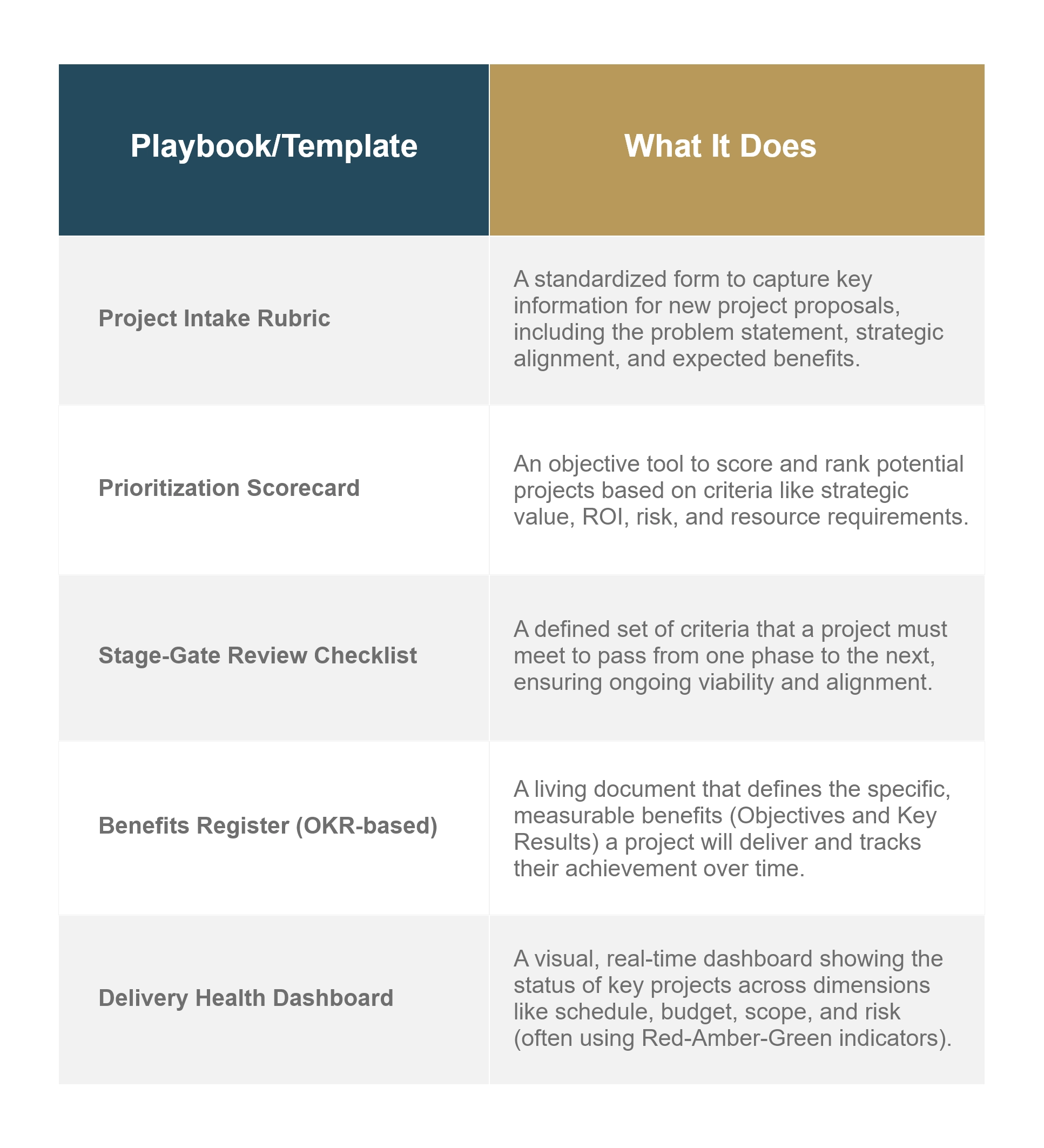
- A standardized intake and prioritization framework.
- A stage-gate or phase-gate review process to ensure projects stay on track.
- A risk and issue management framework (e.g., RAID logs).
- A benefits realization tracking process.
3. Technology: The Single Source of Truth
A modern PMO relies on a Project and Portfolio Management (PPM) tool to provide a centralized, real-time view of all initiatives. This replaces disconnected spreadsheets and provides a single source of truth for all stakeholders, enabling dashboards that visualize portfolio health, resource allocation, and budget performance.
Practical Playbooks for PMO Success
Here are some essential tools a modern PMO uses to drive value:
Funding and Resourcing: PMO vs. PMaaS
Not every organization needs a large, permanent PMO team. Flexible models can provide the right level of support.
- Internal PMO: A permanent, in-house team that builds deep institutional knowledge. This is ideal for large organizations with a continuous flow of complex projects.
- Project Management-as-a-Service (PMaaS): An on-demand model where you engage external project professionals for specific initiatives or to augment your existing team. This provides flexibility, access to specialized skills, and the ability to scale capacity up or down as needed. It’s an excellent option for mid-sized companies or those undergoing a period of intense transformation.
Quick Win Idea: Start with a PMaaS engagement to stand up your PMO framework and demonstrate value quickly. This allows you to build a business case for a long-term internal capability.
Integrating BA and BPM for Better Outcomes
A PMO becomes significantly more effective when it integrates closely with Business Analysis (BA) and Business Process Management (BPM) disciplines.
- Business Analysis ensures the PMO is focused on the right problems. BAs define clear requirements, validate business needs, and articulate the “why” behind each project, preventing the delivery of solutions that don’t solve the underlying issue.
- Business Process Management ensures that the solutions delivered by projects fit seamlessly into the organization’s workflows. BPM experts map current and future state processes, identifying opportunities for efficiency and ensuring that project outcomes are sustainable.
When these functions work together, the PMO can be confident that projects are not only delivered correctly but that they are the correct projects and will be adopted effectively.
Metrics That Actually Matter
A modern PMO tracks both leading and lagging indicators of success.
- Lagging Indicators (Value-focused): These measure past performance and outcomes.
- Benefits Realization: Percentage of targeted financial or operational benefits achieved.
- Portfolio ROI: The return on investment for the entire portfolio of projects.
- Customer/Stakeholder Satisfaction: Scores from post-project surveys.
- Leading Indicators (Health-focused): These predict future performance.
- Project Cycle Time: The average time to move a project from approval to completion.
- Resource Capacity vs. Demand: The ratio of available resources to planned project work.
- Risk Profile: The number of high-priority risks across the portfolio.
Avoiding Common PMO Pitfalls
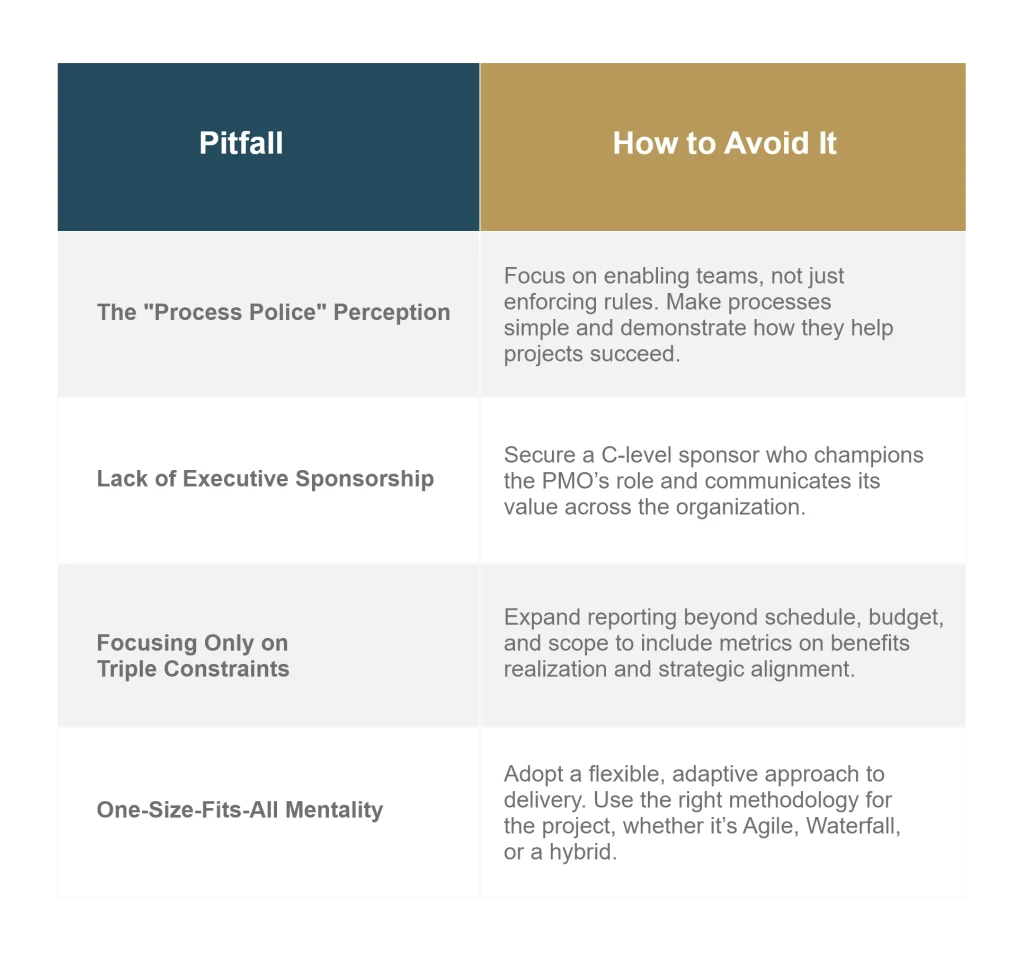
Even well-intentioned PMOs can fail. Watch out for these common traps:
Your Roadmap to a Modern PMO
Evolving your PMO doesn’t have to take years. A focused effort can deliver significant results in just a few months.
- First 90 Days:
- Assess your current state: review processes, tools, and capabilities.
- Gain executive alignment on the future vision for the PMO.
- Develop a standardized project intake and prioritization process.
- Launch a portfolio-level dashboard to create a single source of truth.
- 90-180 Days:
- Implement a benefits realization framework for your top projects.
- Introduce lightweight stage-gate reviews.
- Provide coaching and training to upskill project managers and their teams.
- Demonstrate value with a few quick wins on high-visibility projects.
Turn Your PMO into a Strategic Asset
A modern, value-driven PMO is a powerful engine for turning strategy into reality. By shifting the focus from administrative tasks to strategic outcomes, you provide leaders with the clarity and control needed to make better investment decisions and drive measurable business impact. It’s about ensuring that every dollar spent on projects is a dollar invested in moving the business forward.
At HoCH Solutions, we specialize in helping organizations establish, optimize, and run high-impact Project Management Offices. Whether you need to build a PMO from the ground up, enhance an existing one, or access on-demand project expertise through our PMaaS offering, we provide the independent, insight-driven guidance to ensure your PMO delivers results.
If you are ready to transform your PMO into a strategic business partner, contact HoCH Solutions to discuss how our expert services can accelerate your journey.