



How to Identify and Eliminate Bottlenecks in Your Business Processes
Inefficiency is a silent drain on performance and profit. It doesn’t announce itself with a loud alarm; instead, it shows up as missed deadlines, frustrated teams, and rising operational costs. At the heart of this inefficiency often lies a business process bottleneck — a single point of constraint that dictates the pace of your entire operation. Like a traffic jam on a highway, a bottleneck slows everything down, no matter how efficient the rest of the system is.
Identifying and eliminating these constraints is one of the most powerful ways to improve organizational effectiveness, boost productivity, and enhance your bottom line. A structured approach gives you the clarity to see where work is piling up, the control to fix the root cause, and the confidence that your improvements will deliver lasting value. This guide provides a step-by-step method for finding and fixing the bottlenecks that are holding your business back.

What is a Bottleneck? (And Where Do They Hide?)
A bottleneck is any point in a workflow where the demand for a resource or task exceeds its capacity. This causes work to queue up, increasing wait times and slowing the entire process. While they can appear anywhere, bottlenecks often fall into several common categories:
- Capacity Bottlenecks: A team or machine doesn’t have enough capacity to handle the volume of work. Example: A single senior developer is required to review all code, creating a long queue for deployments.
- Policy Bottlenecks: A rule or procedure creates unnecessary delays. Example: A requirement that all purchase orders over $500 must be signed by a C-level executive who is often traveling.
- System Bottlenecks: A slow or outdated piece of software limits the speed of a process. Example: A legacy CRM system that takes several minutes to load a customer record.
- Handoff Bottlenecks: Delays occur when work is passed between different teams or departments. Example: The sales team submits incomplete order forms, requiring the finance team to seek clarification before processing.
- Decision Bottlenecks: Progress stalls while waiting for a key decision or approval. Example: A project steering committee that only meets once a month to approve scope changes.
A Step-by-Step Method to Find Your Bottlenecks
You can’t fix what you can’t find. A systematic approach to discovery is essential for accurately pinpointing the true source of delays.
Step 1: Define the Value Stream and Scope
Start by selecting a single, critical business process, such as “order-to-cash,” “procure-to-pay,” or “new-hire onboarding.” Clearly define the start and end points. Trying to analyze everything at once leads to confusion.
Step 2: Gather Baseline Data
Collect quantitative data to understand current performance. Key metrics include:
- Cycle Time: Total time from the start to the end of the process.
- Lead Time: Time from when a customer makes a request to when they receive the value.
- Throughput: The number of items completed in a given time period.
Step 3: Map the Process
Visually document the process as it currently exists, not as it’s written in a manual. This is where tools like Business Process Model and Notation (BPMN) are invaluable. The goal is to create a shared understanding of all tasks, handoffs, and decision points.
Step 4: Analyze Time and Queues
With your map in hand, analyze where time is spent.
- Time-in-Stage Analysis: Measure how long a work item spends in each step. Pay close attention to the wait time between steps.
- Look for Queues: Identify where work piles up. A growing queue is the most obvious sign of a bottleneck. This could be a list of unassigned support tickets, a stack of invoices waiting for approval, or a backlog of IT change requests.
Step 5: Engage the Stakeholders
The people who perform the work every day have the best insights. Conduct interviews and workshops with front-line staff, team leads, and process owners. Ask questions like:
- “What is the most frustrating part of this process?”
- “Where do you spend most of your time waiting?”
- “If you could change one thing, what would it be?”
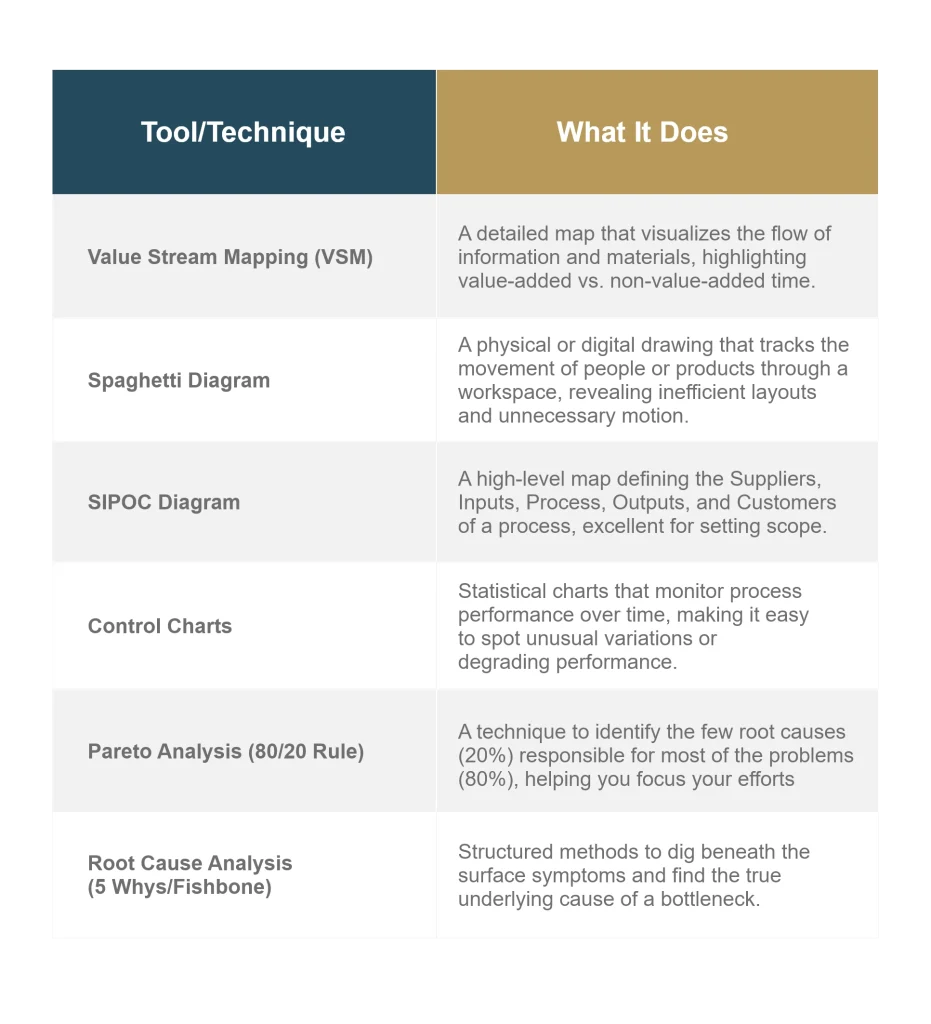
Powerful Tools for Bottleneck Analysis
Several proven techniques can help you visualize and diagnose process constraints.
How to Prioritize Fixes for Maximum Impact
You will likely uncover multiple areas for improvement. Since you can’t fix everything at once, prioritization is key. An Impact vs. Effort Matrix is a simple but effective tool for this.
- High Impact, Low Effort (Quick Wins): Do these immediately. Example: Simplifying a complex approval form.
- High Impact, High Effort (Major Projects): These are strategic initiatives that require careful planning and a business case. Example: Implementing a new ERP system.
- Low Impact, Low Effort (Fill-ins): Tackle these when you have spare capacity.
- Low Impact, High Effort (Time Sinks): Avoid these unless they are a compliance requirement.
A Toolkit of Remedies to Eliminate Bottlenecks
Once you’ve identified and prioritized a bottleneck, you can apply a range of solutions to resolve it.
- Eliminate: Stop performing non-value-added tasks altogether.
- Streamline: Simplify the steps in the process. Can a five-step approval be reduced to two?
- Automate: Use technology to perform repetitive, rule-based tasks.
- Parallelize: Rework the process so multiple steps can happen simultaneously instead of sequentially.
- Add a Buffer: Place a small queue of work immediately before the bottleneck to ensure it never sits idle.
- Standardize: Create clear, repeatable instructions and checklists to reduce errors and rework, a common source of delays.
- Upskill and Cross-Train: Increase the number of people who can perform the constrained task, adding flexibility to the system.
- Improve Governance: Empower employees to make more decisions at lower levels, reducing the need for management approvals.
Sustaining the Gains: The Role of Continuous Improvement
Fixing a bottleneck is not a one-time project. Without ongoing management, processes tend to degrade, and new bottlenecks can emerge elsewhere. Sustaining your improvements requires a commitment to continuous improvement.
- Establish KPIs: Monitor key metrics like cycle time and throughput.
- Use Visual Management: Display performance on dashboards so teams can see their progress in real-time.
- Implement a Cadence: Hold regular (e.g., weekly) process review meetings to discuss performance and identify emerging issues.
- Leverage the PMO: The Project Management Office can provide oversight and ensure that process improvement initiatives are aligned with broader business goals.
Make Your Processes Work For You, Not Against You
Bottlenecks are more than just operational annoyances; they are strategic liabilities that limit growth, frustrate employees, and disappoint customers. By adopting a structured and insight-driven approach, you can systematically uncover and eliminate these constraints, unlocking new levels of performance and efficiency. This provides the control you need to build resilient, scalable operations that can adapt to changing market demands.
At HoCH Solutions, our expertise in Business Process Management and Business Analysis helps organizations achieve clarity and control over their most complex workflows. We provide the frameworks and hands-on guidance needed to transform inefficient processes into sources of competitive advantage.
If you are ready to move faster and with greater certainty, contact HoCH Solutions to discuss how our process improvement services can help you eliminate bottlenecks and accelerate your business.